
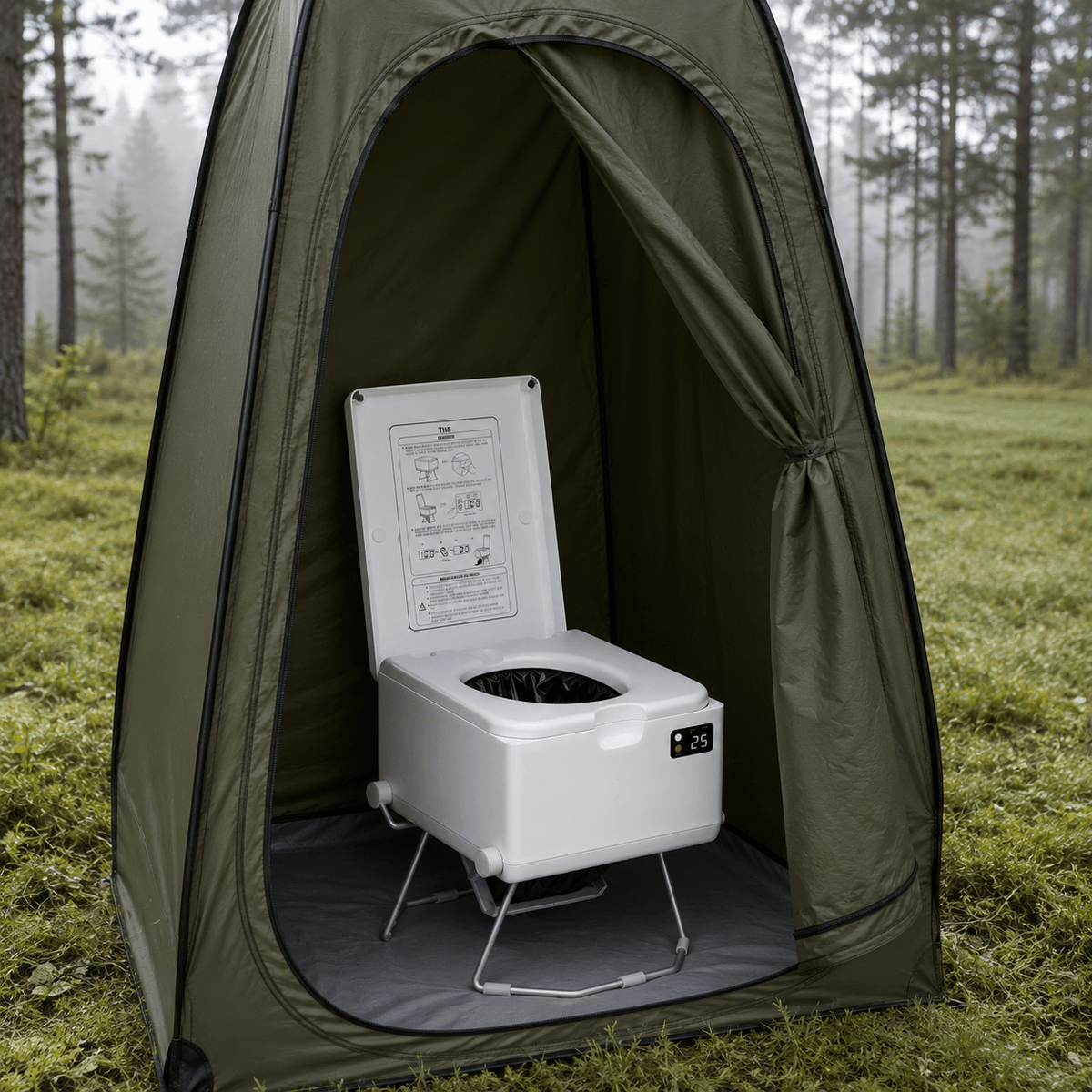

The fastest way to eliminate campsite odor is to seal waste at the point of disposal — before it can off-gas. A dry flush toilet does this; a cassette or chemical toilet does not. For most campers, the Modiwell EVO LE-310 with LooSeal Waterless Sealing is the most practical option currently available.
Who This Guide Is For
This guide is for campers who have dealt with the smell that follows a cassette toilet on a warm afternoon, the blue chemical residue in a portable unit, or the ventilation requirements of a composting system — and want to understand which toilet type actually eliminates odor rather than masking it. Whether you car camp, overland, use a pop-up trailer, or live in a van part-time, this comparison covers every major toilet type on the same criteria so you can make an informed call before you buy. Ready to browse options? See the Modiwell camping toilet collection.
Toilet Type Comparison: What Each Type Actually Does With Odor
The fundamental difference between toilet types is when odor is addressed — at the point of disposal, inside a holding tank, through decomposition, or through incineration. That timing determines how much smell you live with between uses.
| Category | Dry Flush | Cassette | Composting | Incinerating | Chemical |
|---|---|---|---|---|---|
| How it works | Heat-seals waste in a bag after each flush | Stores waste in a removable tank | Separates liquid/solid; composts with airflow | Burns waste to ash | Holds waste in chemical solution |
| Odor control | Excellent — sealed at source, no off-gassing | Poor to moderate — tank off-gases when opened for emptying | Moderate — requires consistent airflow and dry conditions | Excellent — waste destroyed | Poor to moderate — chemicals mask, don't eliminate |
| Setup required | None | None | Vent fan (needs power or solar) | 110V or propane connection | None |
| Waste disposal | Sealed bag into waste bin — no dump station | Empty tank at dump station | Empty compost tray every few weeks | Empty small ash tray | Empty tank at dump station |
| Dump station needed | No | Yes | No | No | Yes |
| Best for | Car camping, overlanding, van life, short-term RV | Budget car camping, short trips with dump access | Fixed off-grid cabins | Fixed installations, boats | Festival use, minimal budget |
| Unit price range | $700 – $1,100 | $80 – $250 | $900 – $2,000 | $2,500 – $5,000+ | $20 – $150 |
Unit price ranges reflect general market categories. Modiwell-specific pricing is not shown in buying guide content.

Key Decision Factors
The single biggest variable is odor mechanism, not odor-masking product. After that, the factors that matter for campers are portability, per-use cost, power dependency, and waste disposal logistics.

Per-Use Cost
| System | Per-Use Cost | Source |
|---|---|---|
| Modiwell LE-310 — Blue refill bag + coagulant | $0.58 | Bag only: $0.47 · 60 uses per pack |
| Modiwell LE-310 — Black refill bag + coagulant | $0.70 | Bag only: $0.58 · 60 uses per pack |
| Other dry flush systems | $1.10 – $1.25 | Third-party review data |
| Cassette / Chemical | Near $0 per use | Dump station fees apply separately |
| Composting | Near $0 per use | Occasional additive cost only |
| Incinerating | $0.15 – $0.25 per burn | Electricity or propane |
Modiwell's per-use cost is among the lowest in the dry flush category, based on third-party review data.
Portability
The LE-310 weighs 16.5 lbs and folds flat for transport — the lightest dry flush option in this category. Cassette toilets run 8–12 lbs for basic units but require transporting waste to a dump station. Composting toilets weigh 20–30 lbs and are not designed for transport. Incinerating toilets run 35–60 lbs and require fixed installation.
Power Requirements
The LE-310 runs on an onboard 57.5Wh rechargeable battery — 70 to 100 flushes per charge. The recommended practice is to charge fully before use rather than running from a power source during active camping. No external power is needed during use. Composting toilets require a 12V or 110V vent fan running continuously. Incinerating toilets require 110V or propane during each burn cycle. Cassette and chemical toilets require no power.
Waste Disposal at a Campsite
Dry flush bags are sealed and contain no liquid. At campgrounds with waste collection facilities (private campgrounds, developed state and national park sites), sealed bags can be placed in standard trash bins. BLM and National Forest dispersed camping areas have stricter rules: solid human waste and waste bags must be carried off public land and disposed of at an approved facility — dumping into BLM trash receptacles or vault toilets is prohibited under federal regulation. National Forest policy permits disposable biodegradable bag systems approved for landfill disposal, provided bags are kept in a leak-proof container until properly disposed of. Always confirm disposal policy with the specific site before arrival.
The Real Math: What a Season of Camping Actually Costs
According to the American Water Works Association, the average American flushes a toilet five times per day at home. Camping typically runs lower — 3 to 4 uses per person per day is a reasonable estimate when some activity happens outdoors. Each Modiwell refill pack contains 60 uses.
Two scenarios, calculated
Use rate based on AWWA 2016 Residential End Uses of Water Study (5 flushes/day average at home), adjusted down for camping context. Actual consumption varies.
Use-Case Decision Framework
The right toilet depends on your camping style, not just the specs. Here is a direct mapping:
Product Recommendation

Share:
Backyard & Pool Area Toilet Without Plumbing: What Actually Works